
Many Samsung users in the United States face issues like slow performance and battery drain after updates. This lag can be short-term or a sign of deeper problems that need fixing.
This guide offers practical steps to fix Samsung phone lag. We start with basic checks like restarting and checking for more updates. Then, we dive into clearing caches, optimizing storage, and managing apps.
We also cover performance tweaks and when to reinstall apps or reset your phone. Remember, always back up your data before making big changes. These tips work for many Samsung models, but results may vary.
Firmware updates bring new security and features, but they can slow things down. Our guide helps you boost your Samsung’s speed without losing those updates.
Key Takeaways
- Post-update lag may be temporary; restart and wait before deeper troubleshooting.
- Clearing app and system cache can resolve many performance issues quickly.
- Freeing storage and limiting background apps helps speed up Samsung models.
- Use developer options and reduce animations for measurable responsiveness gains.
- Reinstall problematic apps first; consider a factory reset only after backing up data.
- Solutions apply across One UI versions, but results depend on model and storage.
Understanding Why Your Samsung Phone Is Lagging
After a firmware update, we often see a slowdown. It’s like the phone has aged overnight. We’ll explore common causes and how new features affect speed. This way, you can fix Samsung phone lag without guessing.
Common Causes of Lag After Updates
Background tasks often cause lag. Android and Samsung services re-index apps and rebuild caches. This uses CPU, RAM, and storage, slowing things down.
App incompatibilities are another issue. Apps not updated for the new firmware can crash or use too much CPU. This makes Samsung phones slow after an update.
Residual or corrupted cache from the old version can also cause problems. Temporary files can freeze or stutter until cleared.
Storage issues matter too. Full or fragmented storage slows down file access and app loading. Check your free space to solve Samsung phone lag.
Firmware bugs can also slow you down. Some updates introduce bugs that affect system services or GPU drivers. These issues slow devices until fixed by Samsung.
Battery-saving rules and thermal management can also slow you down. Power profiles may change after an update, limiting performance. This makes phones feel slow.
Impact of New Features on Performance
New One UI features and services use more resources. Enhanced animations and AI tasks add to CPU and memory use. This slows down your phone.
Visual upgrades need more GPU power. Smoother transitions and richer effects can slow older Galaxy models. Disable unnecessary features to speed up your phone.
Security enhancements and monitoring use CPU and memory. This increases power use and slightly slows down your phone. Review settings to find a balance between security and speed.
| Cause | How It Shows | Quick Action |
|---|---|---|
| Background indexing | High CPU, slow app launches | Wait a few hours; keep device on Wi‑Fi and charging |
| App incompatibilities | Crashes, battery drain | Update or reinstall affected apps |
| Residual cache | Stuttering, erratic behavior | Clear app and system cache |
| Low storage | Slow file access, app lag | Free up space, offload media |
| Firmware bugs | Unusual crashes, UI freezes | Check for hotfix updates from Samsung |
| Power/thermal throttling | Reduced peak performance | Adjust battery mode or cool device |
Initial Steps to Troubleshoot Lag Issues
When a Samsung phone starts lagging after an update, we start with simple checks. These often fix the problem. We recommend trying the following before moving to deeper fixes.
Restart Your Samsung Device
Rebooting clears temporary RAM use and ends background tasks that may be stuck after an update. To restart Samsung devices, press and hold the power or side button, then tap Restart. After the device boots, wait a few minutes so post-update optimization tasks can complete.
If a normal restart does not improve performance, try a soft reset. On many Galaxy phones, press and hold Volume Down + Power for about 10–15 seconds to force a reboot without losing data. This often resolves post-update lag caused by frozen services.
Check for Additional Updates
Some performance issues stem from bugs fixed by follow-up patches. We check Settings > Software update > Download and install to see if Samsung released a quick fix. While here, we recommend updating apps via the Google Play Store, since app updates can resolve compatibility problems that cause slowdowns.
Use a stable Wi‑Fi connection when you update Samsung firmware or apps to avoid corrupted downloads. After installing patches, leave the phone idle for about an hour so background optimization and indexing can finish and reduce the chance of lingering post-update lag.
| Step | Action | Why It Helps |
|---|---|---|
| Basic Restart | Press and hold power/side button → Restart | Clears RAM and restarts background services |
| Soft Reset | Hold Volume Down + Power for 10–15 seconds | Force reboot without data loss; fixes frozen processes |
| Check System Patch | Settings → Software update → Download and install | Installs follow-up fixes to reduce post-update lag |
| Update Apps | Open Google Play Store → Manage apps → Update all | Ensures compatibility after updating Samsung firmware |
| Post-Update Wait | Let device sit idle for ~60 minutes after updates | Allows background optimization processes to finish |
Clear Cache to Improve Performance
When your Samsung device feels slow after an update, clearing cached files can help. It removes temporary data that causes lag without touching your personal files. We’ll show you how to clear app cache and system cache partition safely.
How to clear app cache
Open Settings, tap Apps, then choose the app that’s acting up. Select Storage, then tap Clear Cache. This clears temporary files while keeping app data and sign-ins.
Focus on browsers, social apps, and streaming clients if they use a lot of storage or crash often. Clearing cache for several heavy apps is better than a blanket clear, unless problems persist across many apps.
Clearing system cache: a step-by-step guide
The system cache partition stores temporary OS files used to speed operations. Clearing it can fix issues after firmware updates and may reduce Samsung phone lag.
General recovery-mode steps vary by model. Power off the device. Press and hold Volume Up plus Bixby and Power on models with Bixby, or Volume Up plus Power on models without Bixby. Release when the Samsung logo appears. Use the volume keys to highlight Wipe cache partition and confirm with the Power button. Choose Reboot system now when finished. Wipe cache partition removes temporary system files and does not erase personal data.
Check model-specific instructions on Samsung support for exact button combinations. Ensure the battery is charged before entering recovery mode to avoid interruptions when you attempt to clear cache partition Samsung.
| Action | Purpose | Effect on Data | Best Use |
|---|---|---|---|
| Clear app cache (Settings > Apps > Storage > Clear Cache) | Remove temporary files for individual apps | Preserves app data and sign-ins | When a specific app crashes or uses much space |
| Wipe cache partition (Recovery Mode) | Clear temporary OS files that may cause system slowdowns | Does not erase personal files or settings | After firmware updates or persistent Samsung phone lag |
| Targeted cache clearing for multiple apps | Reduce accumulated temporary files across apps | App data retained; may require reopening some apps | When overall device performance is poor and we want to speed up Samsung |
Optimize Storage Space on Your Phone
After a firmware update, our Galaxy can fill up fast, causing Samsung phone lag. We need a plan to free space and keep performance steady. Below, we show steps to identify big offenders and move media off the device. This helps speed up Samsung and avoid future slowdowns.
Start by checking Storage under Settings > Battery and device care > Storage or open Settings > Storage. This gives an overview of what uses space. To find individual apps, open Settings > Apps and sort by size. App size plus data and cache reveals the real cost of each app.
Identify Storage-Hogging Apps
Look for apps that store lots of media or offline content. Podcast players, offline maps, and messaging apps that save images and videos often top the list. We check both app size and cached data before deciding what to remove.
For seldom-used apps that hold large caches, we either clear those caches, uninstall the app, or disable it if it’s preinstalled and cannot be removed. Clearing caches helps speed up Samsung without losing account data.
Tips for Offloading Media Files
Photos and videos are common culprits. We recommend enabling Back up & sync in Google Photos and then using the Free up space option to delete local copies that are already backed up. That step will free up storage Samsung efficiently.
For music and large downloads, we prefer streaming or deleting local downloads. For podcasts and offline content, we remove older episodes after we confirm they are no longer needed. This reduces storage use and helps prevent Samsung phone lag.
On supported Galaxy models, we move media to a microSD card to keep internal storage lean. We also run Storage recommendations in Battery and device care periodically to remove large files and duplicates.
When other steps fail, we consider clearing system caches from recovery mode with the clear cache partition Samsung option. That action can free temporary system space and often helps speed up Samsung after an update.
Disable Unnecessary Background Apps
After an update, Samsung phones might lag more. We need to check which apps run in the background and cut back on unnecessary activity. Making small changes to background processes can greatly improve speed and battery life.
How to Manage Background Processes
We start by opening Settings, then Battery and device care, and tap Battery to see app usage. This shows which apps use a lot of power and run in the background. Another way is Settings > Apps > See all apps > Battery for app-specific details.
When we find a problem app, we go to Settings > Apps > [App] and tap Force stop. To stop it from starting again, we tap Battery and toggle Background activity or select Optimize battery usage. These steps help control background apps on Samsung phones.
We can also run Device care and press Optimize now to close idle apps and free up RAM. This tool temporarily speeds up Samsung phones. But, some services might reopen if apps have auto-start permission. So, we check app permissions and autostart settings too.
Recommended Apps to Disable
We should disable or uninstall apps that use a lot of power or run in the background often. Look at apps that show frequent wake locks or high background usage. This includes advertising-heavy free apps, redundant preinstalled apps, and social apps that use data a lot.
Consider disabling some weather widgets, aftermarket launchers, and old system utilities that don’t get updates. Limiting background activity for these apps will help speed up Samsung phones and reduce lag after updates.
Be careful with core services like Google Play Services or Samsung System UI. Instead of disabling them, we suggest limiting their permissions and background activity. This way, we avoid breaking essential functions while still reducing lag on Samsung phones.
Adjusting Performance Settings
When a firmware update makes our Galaxy slow, small tweaks can help. We show you how to enable developer tools and adjust animation scales. This way, you can speed up Samsung devices safely, without using risky mods or third-party apps.
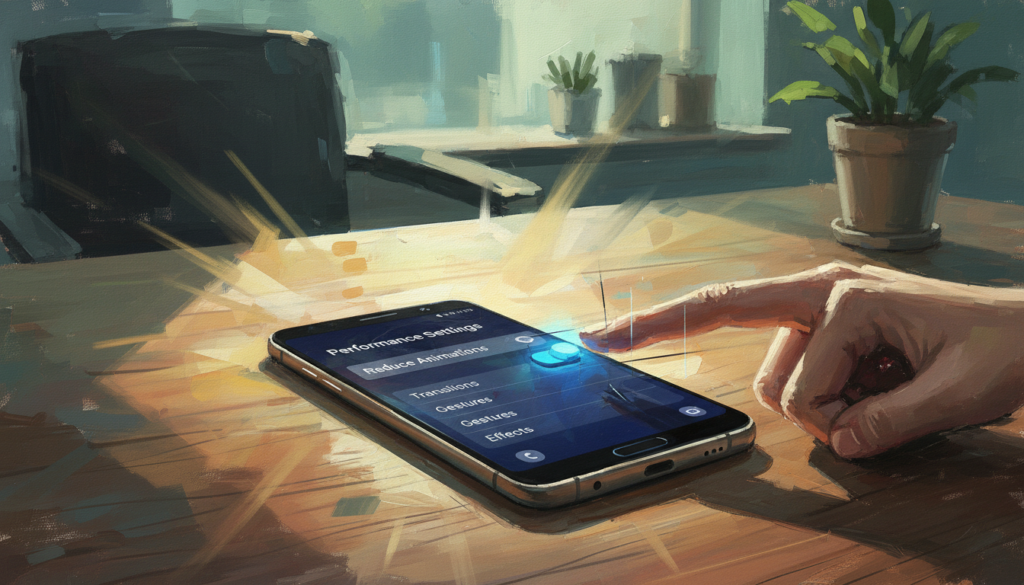
To access deeper controls, start by going to Settings > About phone > Software information. Tap Build number seven times. Then, enter your PIN when asked. This unlocks developer options Samsung in the main Settings list.
In developer options Samsung, we suggest two safe changes. Set Background process limit to 2 or 3 to control background apps. Also, check Window animation scale, Transition animation scale, and Animator duration scale. Set each to 0.5x or turn them off for a faster interface. These steps can make older hardware feel quicker.
But be careful with advanced toggles. Turning off ANR dialogs or forcing background limits can cause apps to act strangely. If an app acts up, change the setting back to fix it.
For a system-level fix without developer options Samsung, go to Settings > Accessibility. Enable Reduce animations if available. This lowers GPU load and can speed up older phones, though it might make them look less polished.
We recommend making changes slowly and testing each one. Reducing animations Samsung and limiting background processes can speed up your Samsung device. But, if you start to have stability issues, go back to the default settings.
Reinstall Problematic Apps
After an update, some apps can slow down your Samsung phone. It’s wise to check these apps before taking big steps. Reinstalling them often solves crashes and speeds up your device without a full reset.
Start by checking apps in Settings. Go to Settings > Apps > See all apps. Tap each app to see Battery and Storage use. Look for high CPU use, background activity, or large data sizes.
Use Android’s Battery and Data usage screens to find troublemakers. If lag stops in Safe Mode, a third-party app is likely the problem.
Identifying apps causing slowdowns
Boot into Safe Mode by pressing and holding Power, then touch and hold Power off and select Safe mode. If your phone runs better, a third-party app is causing the lag. Check recent app updates in Google Play and read reviews for issues after an OS update.
Focus on apps that run all the time in the background. Streaming services, social media, and unknown utilities are common culprits. Remove or reinstall apps that use a lot of battery or data.
Steps to uninstall and reinstall
Here’s how to reinstall apps and fix post-update lag.
- Open Settings > Apps > [Problem App].
- Tap Uninstall. For system apps, choose Disable.
- Restart your phone to clear out old resources.
- Reinstall the app from Google Play for a fresh version.
Reinstalling apps usually keeps cloud data safe. For apps with local data, back up or export data first. If reinstalling doesn’t solve the lag, contact the app developer through the Play Store.
If an app update is the issue, be careful about rolling back. Sideloading older APKs can be risky. Only test older versions if you’re sure they’re safe and compatible.
| Check | Where to Look | Action |
|---|---|---|
| High battery or CPU use | Settings > Apps > [App] > Battery | Uninstall, restart, reinstall |
| Large cache/data | Settings > Apps > [App] > Storage | Clear cache, then reinstall if needed |
| Background network activity | Settings > Data usage or Android Battery usage | Restrict background data or reinstall |
| Suspected third-party conflict | Boot into Safe Mode | Remove recent apps until lag stops |
| Post-update reports | Google Play app page reviews and release notes | Wait for fix, contact developer, or reinstall |
Factory Reset: A Last Resort
When firmware changes cause trouble, a factory reset can fix it. We use this step when other fixes don’t work. It removes system-level problems and conflicting settings.
We consider a factory reset for severe lag, crashes, or system instability. If Samsung support or your warranty technician suggests it, follow their advice. Always back up your data before resetting.
When to prepare a backup
- Start with Settings > Accounts and backup > Backup and restore to sync data with your Google account or Samsung Cloud.
- Use Google Photos or OneDrive to store images and video off-device before wiping the phone.
- Save messages via Google Drive or a trusted third-party app if you want chats preserved.
Methods to secure a full copy
- Use Smart Switch on a PC or Mac to create a complete device backup over USB or Wi‑Fi.
- Manually copy documents and media to a computer by connecting the phone with a USB cable and exporting local files.
- Verify backups by opening a saved photo or message in the cloud or on your computer before you reset.
Clearing the system cache first is also a good idea. A targeted clear cache partition Samsung step can remove temporary files that cause lag without erasing personal data.
When backups look good, follow the reset path: Settings > General management > Reset > Factory data reset > Confirm. After the reset, install essential apps first and test performance before restoring everything from backup Samsung. This staged approach helps confirm whether the reset resolved the Samsung phone lag or if a deeper hardware check is needed.
Maintaining Performance After Fixes
After fixing issues, it’s key to keep up the good work. Post-update lag often gets better with new patches. Regular updates help keep your Samsung phone running smoothly.
Regularly Update Your Software
We check for updates in Settings > Software update often. We also turn on automatic updates on Wi‑Fi. This way, we get patches quickly.
Follow-up fixes often solve problems that cause lag. We update apps in Google Play and the Samsung Galaxy Store too. This keeps everything running smoothly.
Routine Maintenance Tips for Your Samsung Phone
We reboot our phones every week. We clear caches for big apps once a month. Keeping 10–15% free space helps too.
Running Device care optimizations and uninstalling unused apps helps. This reduces background activity and speeds things up.
We back up to trusted cloud services and use Smart Switch for full backups. For older devices, turning off new visual features helps. We also watch battery and thermal health to avoid slowness.
Most lag is temporary and can be fixed with these steps. If problems last, we reach out to Samsung support. They help keep our devices fast and reliable.
Leave a Reply